Avoid your inquiry is delay response, please enter your WhatsApp/Skype along with the message, so we can contact you at the very first time.
We will reply you within 24 hours. If for urgent case, please add WhatsApp/WeChat: +86 16652801818,. Or call +86 16652801818 directly.
*We respect your confidentiality and all information are protected. We will only use your information to respond to your inquiry and will never send unsolicited emails or promotional messages.
Standard forklifts perform beautifully—until they leave the warehouse.
The moment wheels touch mud, gravel, rain-soaked clay, or uneven ground, the machine loses stability, traction slips, and loads begin to sway. Projects slow down. Risks rise. And operators become hesitant.
A rough terrain forklift is engineered to solve that exact problem by turning unstable outdoor surfaces into workable ground rather than obstacles.
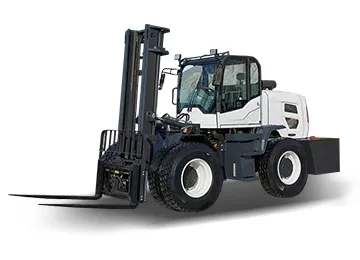
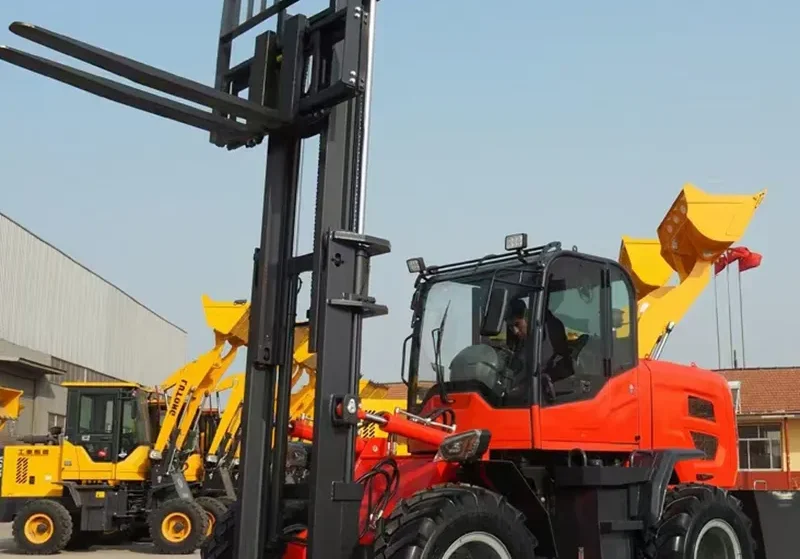
A rough terrain forklift is a heavy-duty lifting machine built specifically for outdoor material handling, where ground conditions are unpredictable: construction sites still under grading, timber yards scattered with roots, farms with rutted access paths, or municipal infrastructure zones with unfinished surfaces. Unlike indoor forklifts optimised for smooth concrete, rough terrain forklifts provide a confident and secure operating platform on land most machines try to avoid.
The modern forklift was born indoors—moving pallets through orderly factory aisles.
As construction, agriculture, forestry and field logistics expanded, the need for a machine that could lift and travel outside controlled environments grew rapidly. Workers tried taking warehouse forklifts outside, only to discover:
Dirt, rocks and slopes caused tipping risks
A new category emerged: the rough terrain forklift, not as an adaptation of warehouse models but as a purpose-built outdoor vehicle.
Manufacturers like HBMC Group, long specialized in construction-grade equipment, embraced the challenge and developed machines that carry the same design DNA seen in excavators, skid steer loaders and telehandlers—durability, load stamina, and rugged engineering first, convenience second
While a rough terrain forklift still lifts loads using forks and a mast, similarities mostly end there.
The true difference lies in the way it holds the ground and carries weight through unpredictable environments.
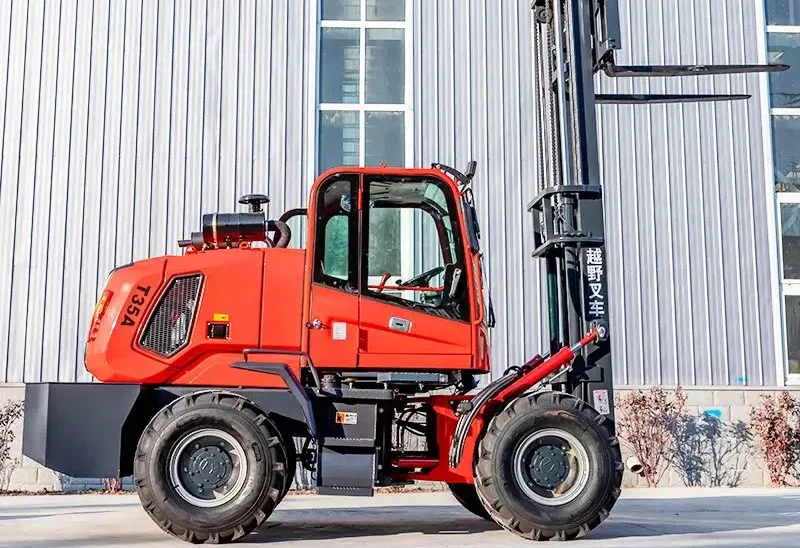
First, the chassis is built heavier and reinforced to manage twisting and vibration created when wheels cross unstable surfaces. The mast—the backbone of lifting strength—is engineered thicker, often with tilting functions to stabilize pallet angles when the forklift is not level.
Second, the wheels define the forklift’s purpose. Instead of flat cushion tires, rough terrain models use large pneumatic tires, sometimes filled or foam-cushioned, providing grip like off-road tires rather than warehouse rollers. These tires allow the forklift to maintain controlled movement across gravel, loose fill, mud patches and uneven slab edges, where standard forklifts simply spin or dig in.
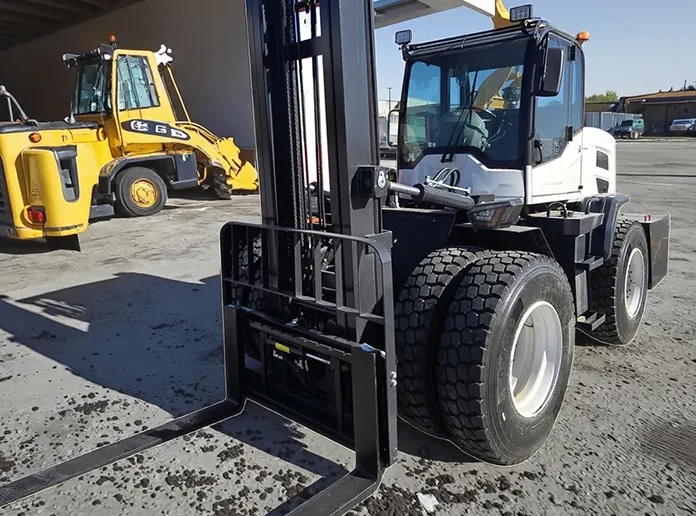
A third differentiator is high ground clearance. Instead of skimming only inches off the ground, rough terrain forklifts sit high—protecting undercarriage components from stones, debris and jobsite irregularities.
Finally, power matters. Outdoor lifting rarely occurs close to electrical outlets, so most rough terrain forklifts run on diesel, supplying torque and fuel endurance that electric motors cannot yet match in the field. This allows the machine to climb mild slopes, recover from wheel slip, and carry its rated load without strain.
The most compelling argument for a rough terrain forklift is where it works—not in theory but in daily operation.
On a construction site, the forklift is often the first powered machine that moves materials across bare ground long before concrete plinths cure or paving is installed. Pallets of brick, rebar bundles, roofing panels, insulation bags and adhesive drums must traverse terrain that may change daily with weather.
In agriculture, a rough terrain unit becomes part of the farm’s backbone, handling seed pallets before planting, feed deliveries during season, and equipment supplies all year. Uneven farm tracks, wet soil, and continuously changing ground condition make a warehouse forklift impractical.
Forestry, landscaping and timber operations benefit even more, where stump roots, soil heave, and loose bark or mulch can defeat smaller machines.
And in government deployments—from military bases to utility yards—the one rule is simple: if a forklift must work outside, reliability is more important than speed.
Can rough terrain forklifts be used on paved ground?
Yes—they work fine on paved areas but are overbuilt for smooth surfaces.
Are rough terrain forklifts difficult to maintain?
No. Diesel engines, pneumatic tires and heavy frames are straightforward to repair with basic service schedules.
Do they replace telehandlers?
They overlap but don’t replace each other. Telehandlers reach farther; mast forklifts carry heavier vertically.
How long do rough terrain forklifts last?
With solid maintenance, thousands of operating hours—long enough to justify ownership over multi-year contracts.

 English
  Arabic
  Turkish
  Spanish
  Portuguese
  Russian