Avoid your inquiry is delay response, please enter your WhatsApp/Skype along with the message, so we can contact you at the very first time.
We will reply you within 24 hours. If for urgent case, please add WhatsApp/WeChat: +86 16652801818,. Or call +86 16652801818 directly.
*We respect your confidentiality and all information are protected. We will only use your information to respond to your inquiry and will never send unsolicited emails or promotional messages.
Your slab pour is scheduled, but the ready‑mix plant is 30 km away, the clock is ticking, and the concrete may set en‑route. Pick the wrong concrete mixer truck and you pour cold joints—or worse, scrap an entire batch. Choose the right mixer truck and the job flows smoothly.
A concrete mixer truck—also called a mixer truck or cement mixer truck—is a heavy‑duty truck with a rotating drum that blends, transports, and discharges fresh concrete. With on‑board water, hydraulics, and precise drum rotation, the mixer keeps the concrete mix agitated until it reaches your construction site, ensuring uniform quality and reducing waste.
A dump truck hauls dry aggregates, but a concrete mixer truck actually mixes concrete on‑site. Inside the steel mixing drum, spiral blades churn the batch while the truck travels. Water tanks fine‑tune slump, while the rear chute or front discharge funnel directs the pour. This pairing of mix and transport concrete tasks in one heavy duty chassis eliminates extra equipment and minimizes delay.
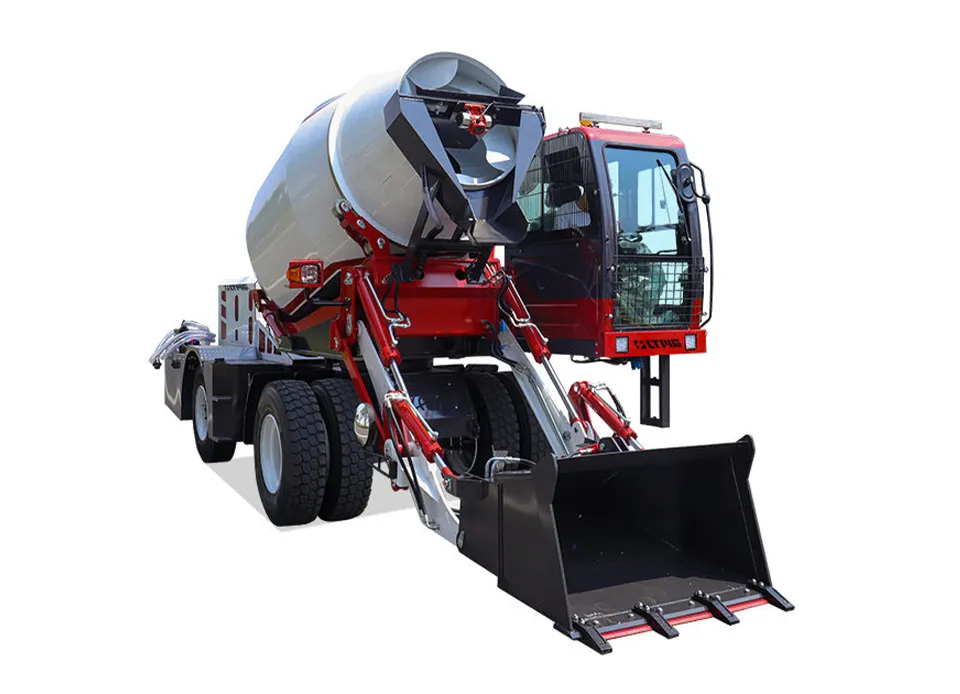
Key components:
| Component | Purpose |
|---|---|
| Rotating drum | Continuous agitation prevents hardened concrete |
| Hydraulic motor | Controls drum speed & direction |
| Water tank | Adjusts slump, cleans chute afterward |
| Rear discharge or front discharge mixer | Directs flow into forms |
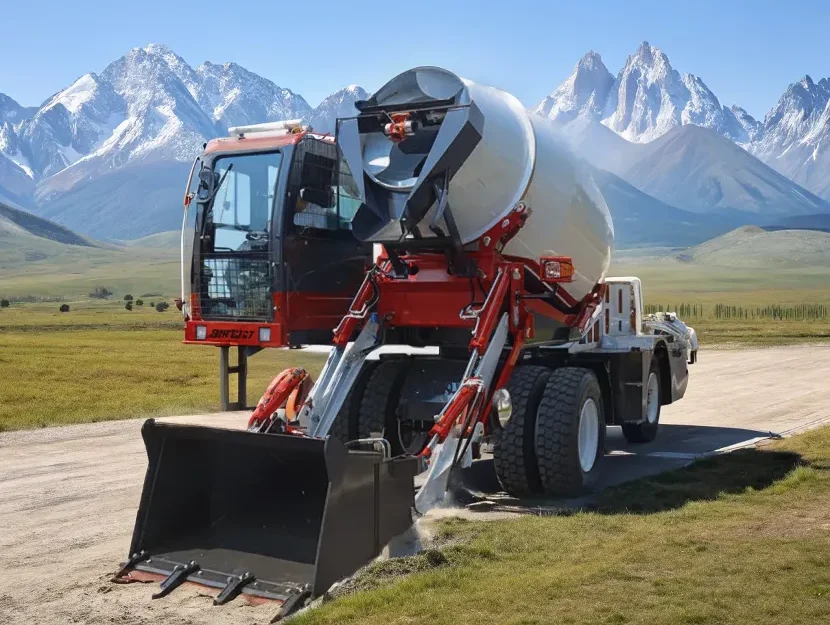
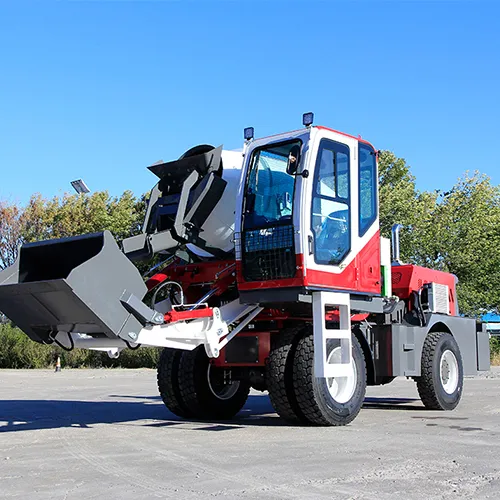
The self-loading concrete mixer truck is powered by a robust 91/92 kW engine (4108 or 6105 models) and features a 280/315 separated gearbox with a 2.5T drive axle for smooth torque transmission. With a top speed of 25 km/h and a 4×4 traction system, it excels in off-road conditions. The 16/70 R22.5 double tires ensure superior stability and traction, making it ideal for remote job sites and rural infrastructure projects. This combination of power, durability, and adaptability guarantees efficient performance in demanding construction environments.
With a 3.3 m³ mixing capacity and 0.65 m³ batch volume, this mixer truck ensures efficient production. Its 1:28 reduction ratio and ≥15 laps/min speed enable rapid, uniform mixing. The HL6F-82700 reducer ensures durability, while the 7670×2800×3200 mm compact design enhances maneuverability. Weighing 9500 kg, it balances payload and mobility, making it ideal for contractors seeking high output and precision.
This mixer truck features a heavy-duty chassis, 4×4 traction, and a 3200 mm wheelbase for stability. Its 6760×2800×4100 mm extended frame enhances durability, while the double-tire setup reduces ground pressure. Easy-to-maintain components, including a domestic reducer, lower lifecycle costs. Ideal for construction, mining, and agriculture, it ensures reliability and efficiency.
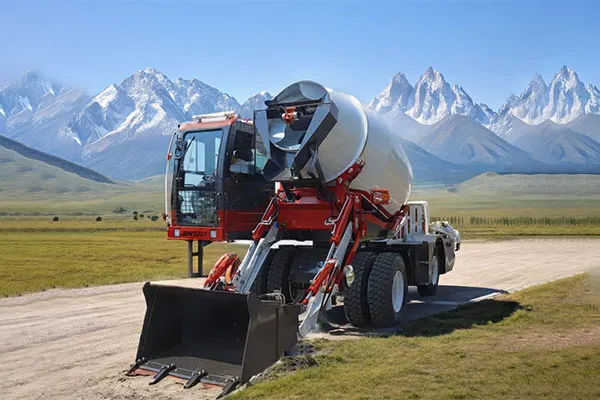
Rear discharge mixer trucks dominate urban work—driver backs into place while a chute man guides the pour. Front discharge mixers like Oshkosh put the cab behind the drum; one operator steers, spins, and pours with joystick controls, cutting labor.
| Truck Category | Crew Needed | Turning Advantage | Best For |
| Rear discharge | Driver + chute man | Shorter wheelbase | Tight city pours |
| Front discharge | Driver only | Cab view of pour | Remote job site & highway |
If your construction projects happen on winding mountain roads, choose the truck that offers visibility and maneuverability—often the front discharge mixer.
Daily wash‑outs are non‑negotiable—hardened concrete adds dead weight and ruins balance. A 15‑minute rinse with on‑board water and drum spin clears fins. Weekly greasing of hydraulic pumps and chute pivots prevents seizure.
| Maintenance Task | Frequency | Benefit |
| Drum wash | After every pour | Avoids buildup |
| Hydraulic oil check | Weekly | Prevents pump failure |
| Chute liner inspect | Monthly | Keeps smooth flow |
What’s the difference between a concrete mixer truck and a volumetric mixer?
A standard mixer truck transports premixed concrete; a volumetric mixer batches ingredients on‑site, ideal for multiple type of concrete pours.
How many cubic yards can one truck haul?
Most trucks typically carry 8–10 yd³; specialized units haul 12 cubic yards for larger projects.
Can I use one truck for smaller pours?
Yes. Volumetric truck technology lets you batch smaller batches—pay for what you pour.
How do I keep the drum from seizing?
Rinse after every pour and inspect the mixing drum fins weekly to avoid hardened concrete buildup.
Is it worth buying a used mixer?
Absolutely, if you verify drum thickness, PTO hours, and service history—many fleets rotate every five years.

 English
  Arabic
  Turkish
  Spanish
  Portuguese
  Russian